
Meghan Markle and the fairy tale of dominance.
Dominant? Recessive? We reveal what our hair colour really tells us about genetics. We’ve got cartoons, royals and a dash of science for you!
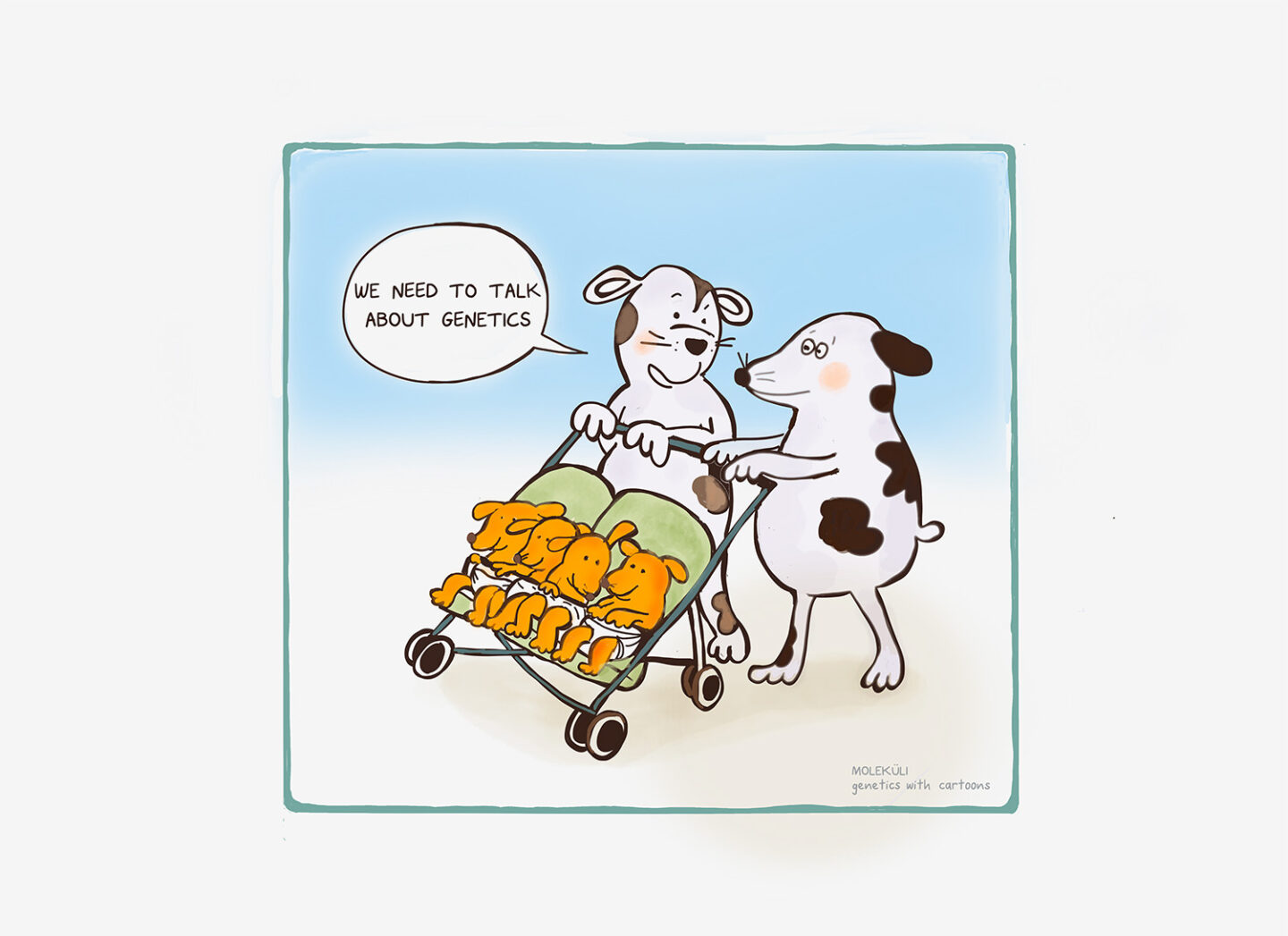
The internet is full of opinions about the children of Meghan Markle and Prince Harry, and surprisingly, a lot of them involve genes.
“Black hair is dominant, how can the child be red-haired?!”
“I’ve never seen red-haired children of mixed heritage!!”
“I don’t think it’s genetic at all!”
As a geneticist, I hear statements like these all the time.
The good news is that genetics can make this much less mysterious. Red hair is not just a royal quirk; it is a perfectly normal result of everyday genetics.
In this article, I use cartoons and a little science to explain how carrier status, recessive genes, and the inheritance of hair colour work. You might even spot your own family in the story!
So, What Do “Dominant” and “Recessive” Actually Mean?
When two people have a child, they each pass on 50% of their genes. That makes sense, but it’s often misunderstood.
People often say, “The child has inherited its father’s eye colour.” In reality, a child inherits eye colour genes from both parents, and it’s the interaction between those two sets that matters.
One gene takes over. That is the dominant gene. The other steps back. It does not change the visible trait, but it is still part of the child’s genetic story.
People often assume, “My partner has black hair, so our child will too.” But genes do not work that way.
Just because someone has black hair does not mean that is the only colour they can pass on. That is like saying:
“He wears sweatpants every day, so he probably doesn’t own any Bermuda shorts.”
Even people with dark hair can carry the red hair gene and never know it.
So How Does It Work?
The most common version of the gene says, “Let’s go for black hair.” The recessive gene, in a small voice, suggests, “Oh, I would love red hair!”
But unless the recessive gene gets backup from the other parent, no one listens. A baby will only have red hair if both parents pass on the red hair gene.
What Genes Actually Do
Genes are small sections of DNA, but they have a surprisingly strong influence.
They determine whether your hair is curly or straight, whether it is red, blonde, or black, whether you can digest milk, and maybe not directly, whether you talk to sheep while quad-biking.
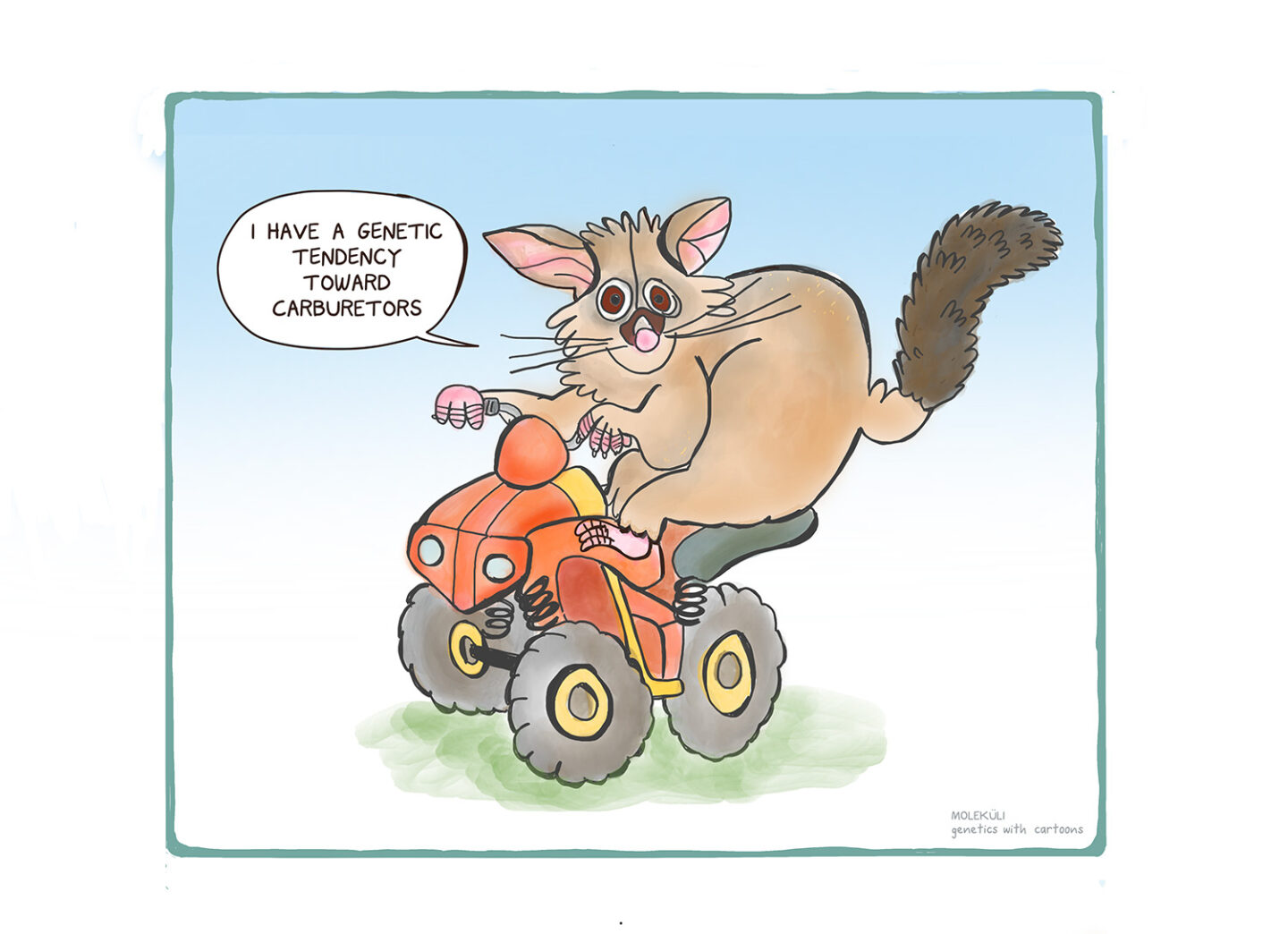
So how does inheritance work? My cartoon shows exactly that:
Every baby gets 50% of its genes from its mother and 50% from its father. But not every inherited trait is immediately apparent. Some genes take the lead (those are called dominant), while others stay in the background – recessive.
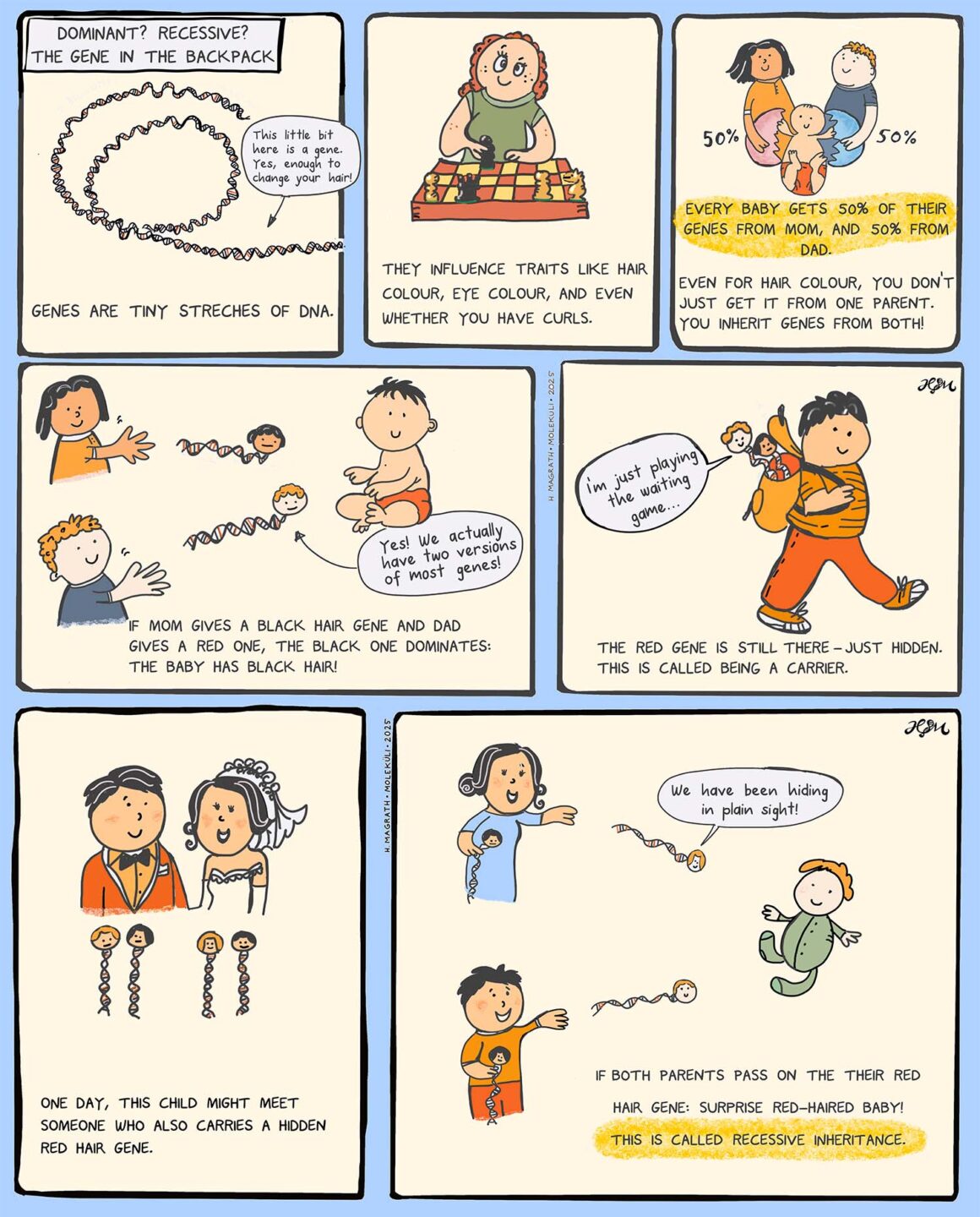
A good example: hair colour.
Let’s consider two parents, one with a dominant black hair gene and the other with a recessive red one. The baby inherits both genes, but the one responsible for dark hair takes centre stage. The other gene is relegated to the background.
What then happens to the red gene?
The red gene is not going anywhere! It is just waiting there for the right moment in the child’s genetic backpack… thinking: “My time will come.” That is what we call carrier status.
And if that child later meets someone who is also carrying the red gene… voilà! A red-haired baby.
Sometimes, a baby brings back a trait no one has seen in generations. It is like a family tree remix!
Red Hair: The Underestimated Gene
Red hair is rare. It really stands out. And for many of us, it still feels like a genetic mystery. But recessive traits like red hair are masters of disguise.
They can stay hidden for generations, then suddenly reappear bold and bright.
Let’s Bring This Back to Royal Reality
- Meghan has black hair. The gene for black hair is dominant, and it usually covers up other colours.
- Harry has red hair, which means he inherited two red gene variants (r/r), one from Charles and one from Diana.
- Meghan has one black gene (B) and one red gene (r). That makes her a carrier.
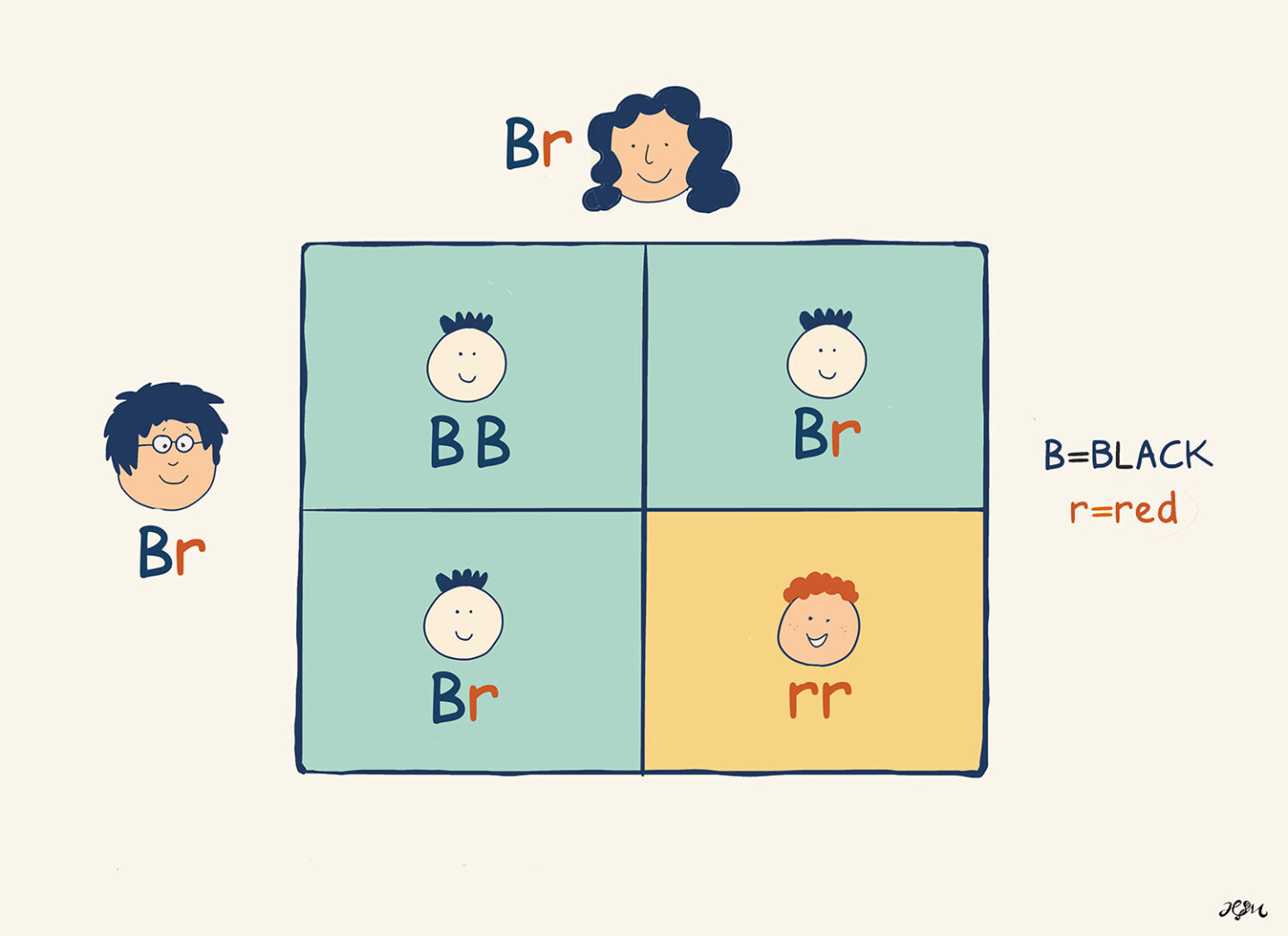
In our cartoon, B represents black (dominant) and r represents red (recessive). We made them different sizes so you can easily see which one takes the lead.
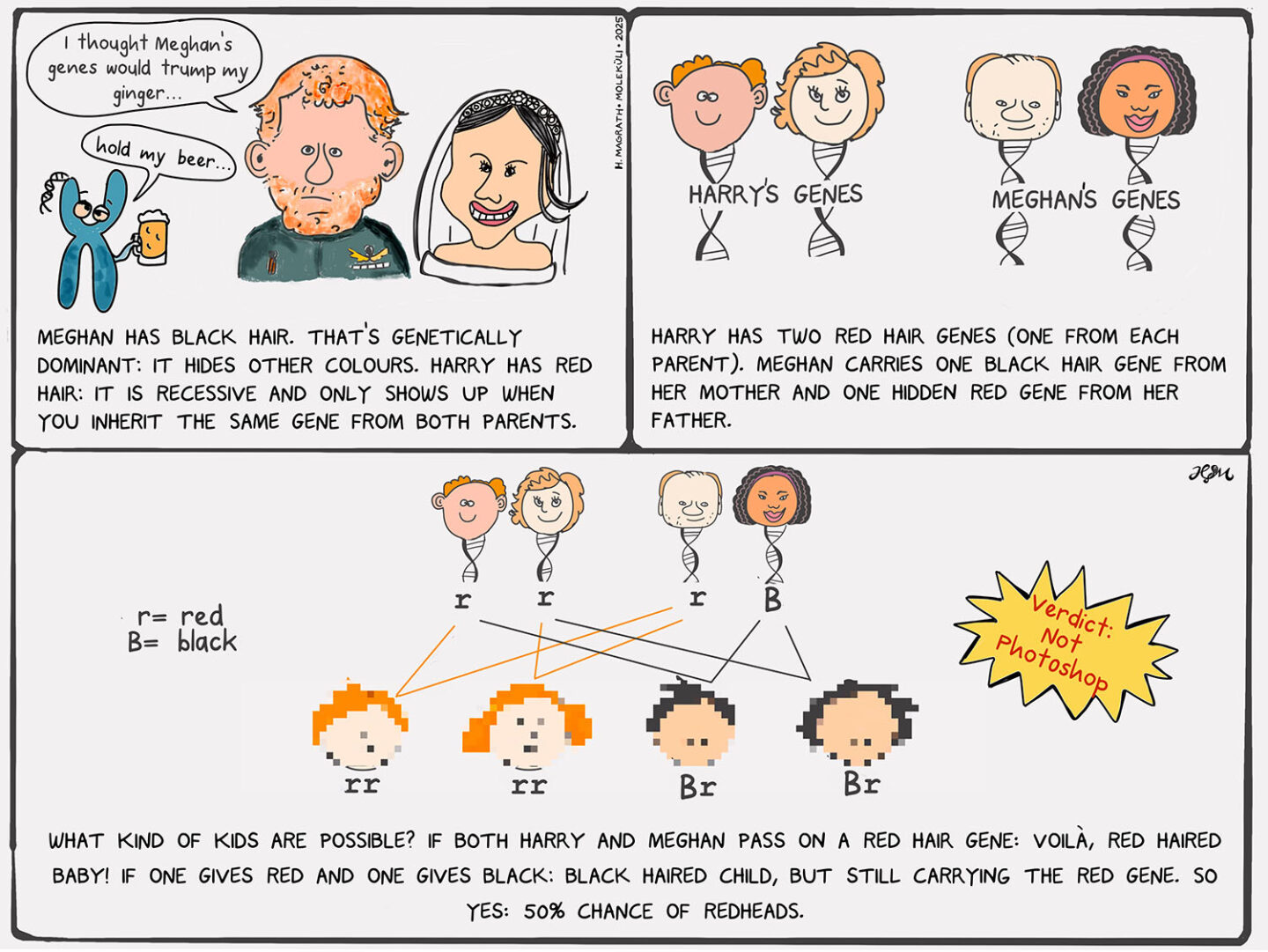
And now the plot twist: If both parents pass on their “r” gene: The child will have red hair.
That means: Each child has a 50% chance of being a redhead.
But that doesn’t mean every second child will be a redhead. It is like flipping a coin: Each toss is independent, but the chance is always 50:50.
The next cartoon shows the four basic combinations: Two lead to red hair (r/r), two to black hair (B/r).
Molecular Disclaimer
Hair colour is not determined by just one gene. There are at least 11 genes involved, along with other factors such as hormones, epigenetic influences, mitochondrial signals, and things like age, lifestyle, and UV exposure.
Yes, the cartoon is a simplification. But the basics still hold: black is dominant, and red is recessive.
So Why Is Red Hair Such a Big Deal?
Maybe because it is rare. Only 1–2% of people worldwide have naturally red hair. In places like Scotland, Ireland, and New Zealand, it is more common.
In some cultures, red hair is seen as magical. In others, it can become an easy target for school bullies.
In reality, it is an entirely natural genetic process involving a pigment called pheomelanin, which replaces eumelanin, the pigment responsible for brown or black hair.
Fun fact: Redheads often react differently to painkillers and may need higher doses at the dentist.
Wait… Did Someone Actually Ask That?
Yes, they did.
Weird Questions, Real Answers
1. “Is it true redheads don’t have a soul?”
No.
This is an old internet meme, popularised by South Park, with similar intellectual roots to the saying “Blondes are dumb”.
2. “Are redheads a mutation?”
Yes, but so is everyone.
Red hair typically results from “loss-of-function” mutations in the MC1R gene, which effectively switches off the “produce eumelanin” setting. Instead, the body produces pheomelanin, resulting in red hair.
This is neither dangerous nor a fault. It is simply a natural variation.
3. “Can I turn into a real redhead by activating a red hair gene later in life?”
Technically, yes, but only with CRISPR gene editing. Realistically, the answer is no.
From a financial perspective, it would probably be easier to buy a hair dye company.
4. “Is the red hair gene from Ireland?”
Not from Ireland, but it is very common there. Around 30–40% of people in Ireland carry a variant of the red hair gene.
However, the gene itself is not Irish. In fact, it is as old as the Neanderthals.
See the next question.
5. “Did early humans have red hair?”
Yes.
One variant of red hair was found in Neanderthals (Lalueza-Fox et al., 2007).
6. “Why do I have brown hair and a red beard?”
The genes that control pigment production are regulated differently depending on the body part, and beards are often affected.
The beard has its own set of rules. A recessive variant in the MC1R gene (the “red hair” gene) can come through here.
Imagine your genes are clothes in a wardrobe. The head always wears the black trousers of genetic dominance. The beard, on the other hand, pulls out a pair of red Bermuda shorts from the back of the DNA closet.
This is what we call regional gene expression.
7. “Was Snow White secretly a redhead?”
Possibly. Even if her hair was black, she may have carried the red hair gene.
“Skin as white as snow, lips as red as blood…”
That is a classic MC1R carrier phenotype: very fair skin and visibly red lips, even without red hair.
Whether royal or recessive, genes do not care about titles.
They follow simple yet surprisingly artistic rules. Once you understand them, they are easy to grasp. And often more interesting than the royals themselves.
Want to Know More?
Curious why blonde toddlers go brunette? Why cancer treatments change hair texture? Why we go grey?
Check out the cartoon article: “Epigenetic Grey: A Colour Story.”
Questions?
We answer even the weirdest questions kindly. Even the Neanderthal ones.